Home / UK calculators / Stone and sand
MOT Type 1 calculator
Work out MOT Type 1 sub-base for patios, paths and driveways. UK units: metres, centimetres and litres. Results update as you type.
How much MOT Type 1 do I need?
MOT Type 1 needed = length × width × compacted depth × 2.1 tonnes per m³. A 4 m × 3 m patio at 10 cm (100 mm) needs 1.2 m³, about 2.5 tonnes, which is three 0.85 t bulk bags. A 6 m × 3 m driveway at 15 cm (150 mm) needs about 5.7 tonnes.
On this page
Key facts
- Compacted MOT Type 1 weighs about 2.1 tonnes per m³.
- Patios and paths usually need 10 cm (100 mm) compacted; drives 15 cm.
- A 0.85 tonne bulk bag covers about 4 m² at 10 cm.
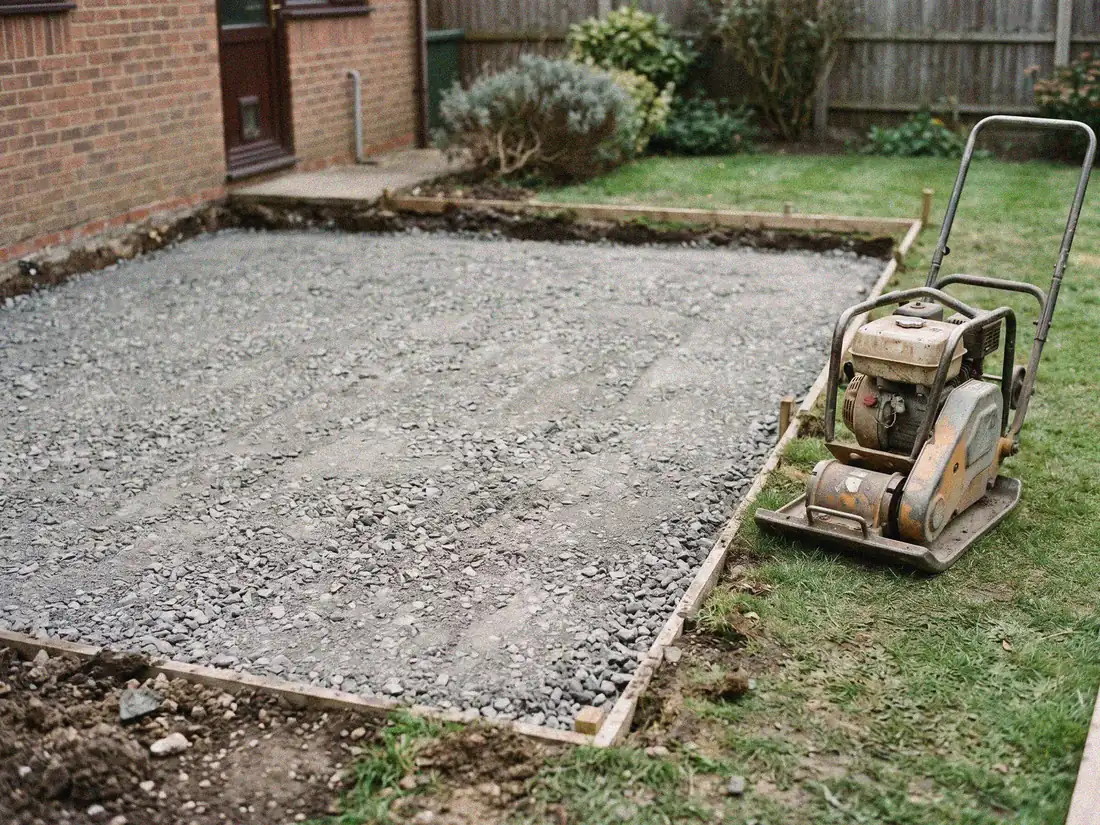
- Compact in layers with a plate compactor.
What is MOT Type 1?
MOT Type 1 is a crushed stone sub-base, graded from about 40 mm down to fine dust. The mix of sizes locks together when compacted, making a firm, free-draining base for patios, paths, sheds and driveways. The name comes from the highway specification it was originally made for. Recycled Type 1, made from crushed concrete and rubble, is also widely sold and is often cheaper.
How deep should the sub-base be?
Depths are always measured after compaction. These are common minimums for UK gardens on firm ground:
| Project | Compacted depth | Notes |
|---|---|---|
| Patios and garden paths | 10 cm (100 mm) | Pedestrian use only |
| Shed and summerhouse bases | 10 cm (100 mm) | Under slabs or a concrete pad |
| Car driveways | 15 cm (150 mm) | Soft ground or heavy vehicles may need more |
| Artificial grass base | 5–7.5 cm (50–75 mm) | Often topped with sharp sand or granite dust |
Clay, soft or wet ground may need a deeper sub-base or a geotextile membrane underneath, so check local guidance for your soil.
Tonnes, bulk bags and bags
Sub-base is sold by weight. This calculator uses a typical compacted density of 2.1 tonnes per m³, so the result already includes the extra material that compaction squeezes in. You don’t need to add a separate compaction allowance.
| Depth | One 0.85 t bulk bag covers | One tonne covers |
|---|---|---|
| 10 cm (100 mm) | about 4 m² | about 4.8 m² |
| 15 cm (150 mm) | about 2.7 m² | about 3.2 m² |
For small jobs, 25 kg handy bags are easier to carry. For anything larger than a small path, bulk bags or a loose tipper delivery are usually much better value. Use the Check prices links below the calculator to compare.
How to lay it
- Dig out to the depth of the sub-base plus your bedding layer and paving.
- Lay a weed or geotextile membrane on soft ground.
- Spread the Type 1 in layers of about 5–7.5 cm (50–75 mm).
- Compact each layer with a vibrating plate compactor before adding the next.
- Check levels and falls so water drains away from buildings.
Then add the bedding layer; the sharp sand calculator works that out.
What mistakes should I avoid?
- Measuring loose depth instead of compacted depth. Type 1 loses a lot of height when compacted.
- Compacting one thick layer. Compactors only firm the top part properly; work in layers.
- Skimping on driveways. 10 cm (100 mm) is not enough for cars on most ground.
- Forgetting the dig-out. Plan how you’ll remove the excavated soil, which takes up more space than you expect.
How is it calculated?
Volume = length × width × compacted depth, with depth entered in centimetres and converted to metres (cm ÷ 100). Weight = volume × 2.1 t/m³. Bags = weight ÷ bag weight, and bulk bags = weight ÷ bulk bag weight, both rounded up. Real densities vary between about 2.0 and 2.2 t/m³ depending on the stone and moisture, so allow a little extra.
Worked examples
Patio: 4 m × 3 m at 10 cm = 1.2 m³ × 2.1 = 2.52 tonnes. That’s three 0.85 t bulk bags, or about 101 × 25 kg bags.
Driveway: 6 m × 3 m at 15 cm = 2.7 m³ × 2.1 = 5.67 tonnes, about seven 0.85 t bulk bags. For this size, a loose tipper load is often more economical.
Common questions
How much MOT Type 1 do I need per m²?
At 10 cm (100 mm) compacted depth, about 0.21 tonnes per m². At 15 cm (150 mm), about 0.32 tonnes per m².
How many tonnes is a m³ of MOT Type 1?
Around 2.1 tonnes once compacted, typically between 2.0 and 2.2 depending on the material and moisture.
What depth of MOT Type 1 for a patio?
About 10 cm (100 mm) compacted is the usual minimum for patios and paths on firm ground.
What depth of MOT Type 1 for a driveway?
About 15 cm (150 mm) compacted for cars on firm ground. Soft or clay ground may need more.
Is recycled Type 1 as good as virgin stone?
For most garden patios, paths and shed bases, good-quality recycled Type 1 performs well and is often cheaper. Check it’s clean and well graded.
Do I need a compactor?
Yes. A vibrating plate compactor, available from hire shops, is needed to get a firm base. Hand tamping isn’t enough for patios or driveways.
How much will 20 tonnes of MOT Type 1 cover?
About 63 m² at 15 cm deep, at a typical density. See the coverage table for other depths.
How much area does a tonne of MOT Type 1 cover?
About 3 m² at 15 cm deep.
How much does a 1 tonne bag of Type 1 cover?
About 4.8 m² at 10 cm compacted, or about 3.2 m² at 15 cm, at a typical 2.1 tonnes per m³ once compacted.
What is the difference between Type 1, Type 3 and scalpings?
Type 1 is a graded crushed stone with fines that compacts into a solid base. Type 3 has fewer fines, so it drains better but is less firm; it’s often used under permeable paving. Scalpings are a cheaper, more variable crushed material, fine for paths and as a general fill.
Is hardcore the same as Type 1?
Not quite. Hardcore is a general term for broken brick, concrete and stone used as fill. Type 1 is a specified, graded material that compacts more reliably, so it’s preferred under patios and driveways.