How to lay artificial grass (UK guide)
Artificial grass is one of the most popular garden projects right now, and it’s very DIY-friendly. The finish depends almost entirely on the base underneath, and on ordering the right amount of grass, which is rarely the same as your lawn’s area.
The short version
Dig out about 75–100 mm, lay and compact a sub-base, add a fine laying course, put down a weed membrane, then roll out the grass with all the pile facing the same way. Join strips with tape and adhesive, trim the edges, and brush in kiln-dried sand. A 6 × 4.5 m lawn needs 38.6 m² of grass, not 27 m². The reason is below.
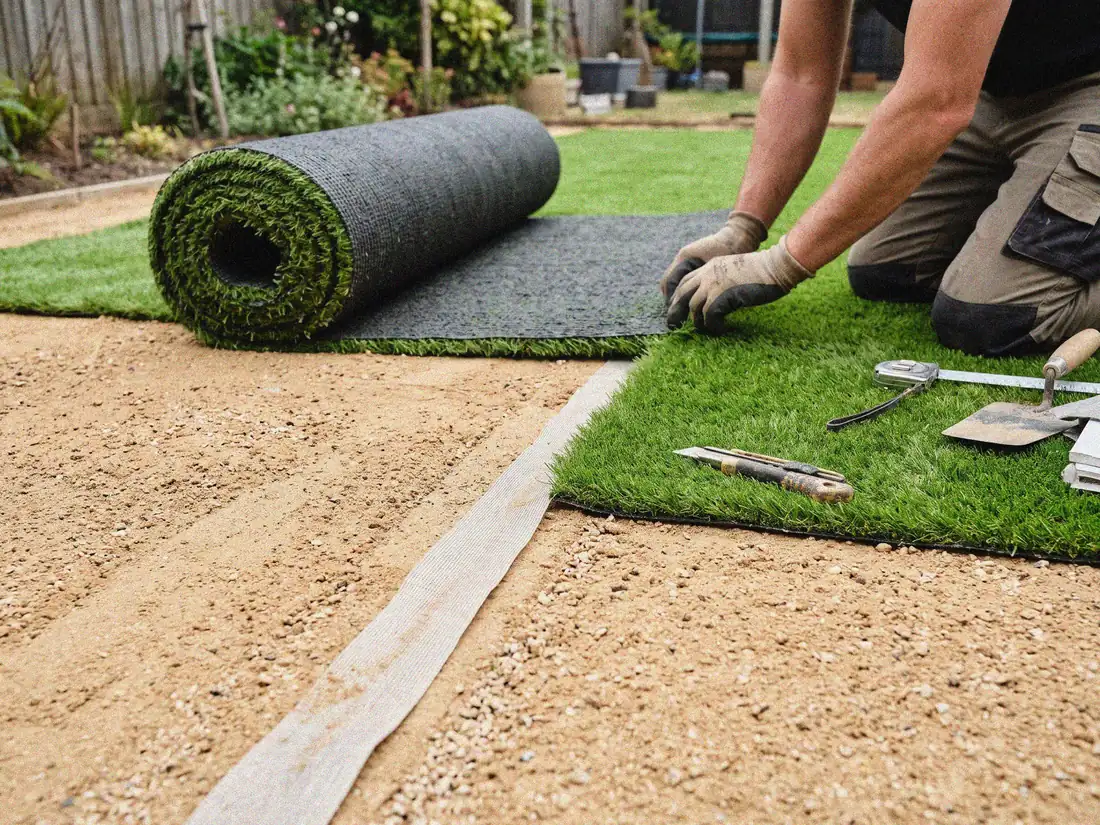
Why you buy more grass than your lawn size
Artificial grass comes in rolls of a fixed width, usually 2 m or 4 m. You can order any length, but you always pay for the full width. So a lawn rarely divides neatly into strips.
Take a 6 × 4.5 m lawn (27 m²) with a 4 m roll. Laying strips across the 6 m side needs two strips (4 m + 4 m = 8 m, to cover 6 m), each 4.5 m long. That’s 36 m² of whole strips. Add 5% for trimming and you order about 38.6 m². Turning the strips the other way would mean two 6 m strips: 48 m² and much more waste.
The artificial grass calculator tries both directions and both roll widths, and picks the layout with the least waste.
The base, layer by layer
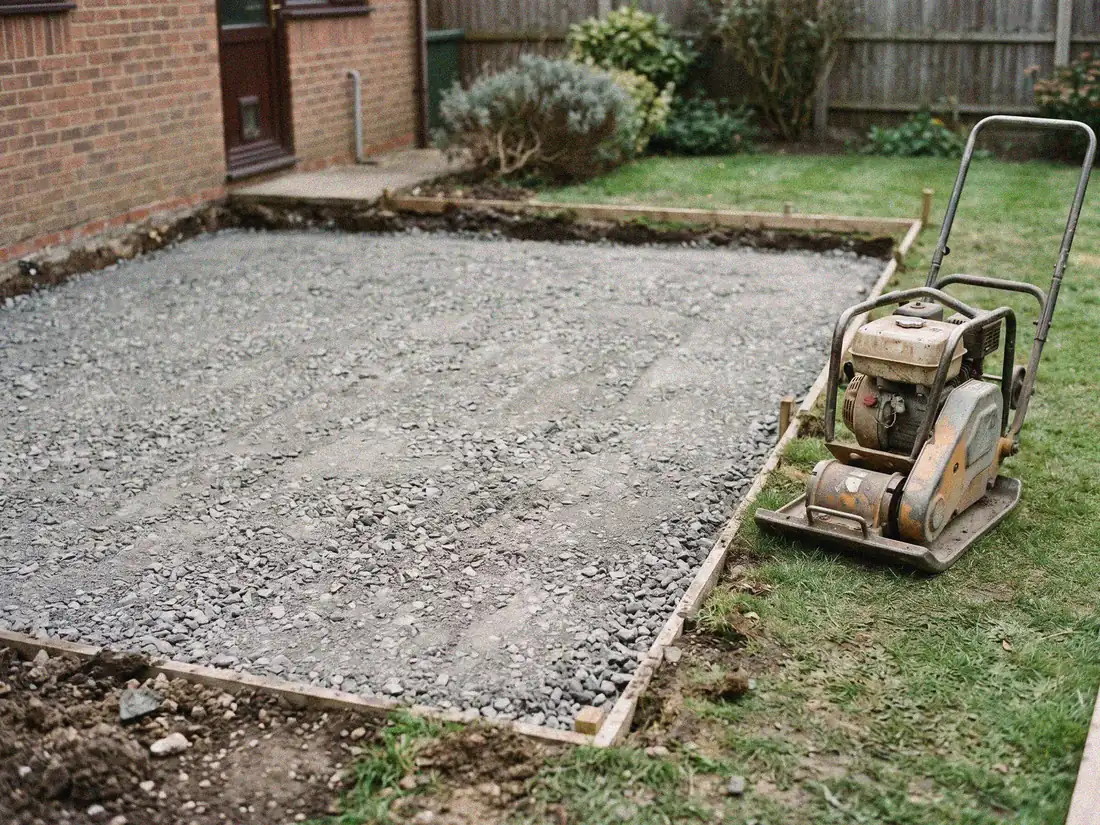
| Layer | Typical depth | Purpose |
|---|---|---|
| Sub-base (MOT Type 1 or similar) | About 50–75 mm, compacted | A stable, free-draining foundation |
| Laying course (sharp sand or granite dust) | About 25 mm | A smooth, fine surface for the grass |
| Weed membrane | — | Stops weeds growing through |
| Artificial grass | Pile height varies | The finished surface |
Granite dust (often called whin dust) is popular for the laying course because it compacts firmly and smoothly. Sharp sand also works.
Step by step
- Remove the old turf and dig out about 75–100 mm.
- Fix edging (timber, steel or plastic) around the perimeter to hold the base and give you something to fix the grass to.
- Lay and compact the sub-base with a plate compactor.
- Spread and compact the laying course, then screed it smooth with a straight board.
- Lay the weed membrane, overlapping any joins.
- Roll out the grass and leave it for an hour or two to relax.
- Check the pile direction: every strip must face the same way, ideally towards the house.
- Join the strips with joining tape and adhesive, butting the edges tightly.
- Trim the edges with a sharp knife and fix them down.
- Brush in kiln-dried sand, typically 4–8 kg per m², against the pile so the blades stand up.
What the 6 × 4.5 m lawn needs
| Item | Amount |
|---|---|
| Artificial grass | 38.6 m² (2 strips of 4.6 m from a 4 m roll) |
| Joining tape | 4.6 m |
| Weed membrane | About 30 m² |
| Kiln-dried sand infill | About 135 kg (6 × 25 kg bags) at 5 kg/m² |
Mistakes to avoid
- Laying straight onto soil. It settles unevenly and weeds push through.
- Mixing pile directions. The two halves look like different colours.
- Ordering by lawn area. You pay for whole strips, so plan the layout first.
- Skipping the infill. It weighs the grass down and helps the blades stand upright.
- Using blunt blades. Change knife blades often for clean edges and joins.
Calculators for this job
More guides
 UK skip sizes explained: what each skip holds
 How to lay turf: a step-by-step UK guide
 How to lay a self-binding gravel path (UK guide)
Barrowload guide · UK · Figures are typical; always check your product and local rules.