MOT Type 1, Type 3, scalpings or hardcore: which sub-base do you need?
Ask a builders’ merchant for “sub-base” and you’ll be offered at least four things with confusingly similar names. They aren’t interchangeable, and picking the wrong one is one of the most common reasons patios sink and drives rut. Here’s how to choose.
The short version
- MOT Type 1 is the default for patios, paths and driveways. It compacts into a hard, stable layer.
- MOT Type 3 is for permeable surfaces, where water needs to drain down through the base.
- Scalpings are a cheaper, more variable option, fine for garden paths and general levelling.
- Hardcore is broken brick and concrete, used as bulk fill underneath a proper sub-base, not instead of it.
The four side by side
| Material | What it is | Drains? | Best for |
|---|---|---|---|
| MOT Type 1 | Crushed rock or concrete, graded from about 31.5–40 mm down to dust | Not much: the fines lock it solid | Patios, paths, driveways, shed bases |
| MOT Type 3 | Crushed rock with most of the fine dust removed | Yes, freely | Permeable paving and other surfaces that drain through |
| Scalpings | A by-product of quarrying or crushing; quality varies | Some | Garden paths, general levelling, temporary tracks |
| Hardcore | Broken brick, block and concrete | Varies | Bulk fill below a Type 1 layer |
Type 1 takes its name from the Department for Transport’s highway specification (the “MOT” comes from the old Ministry of Transport). The mix of stone sizes and dust is what makes it work: when you compact it, the dust fills the gaps and the whole layer locks together.
Recycled Type 1 (crushed concrete and brick) is widely sold and usually cheaper. Good recycled material works well; poor batches can contain soil, plastic or wood. If you can, look at a sample before you buy.
When Type 3 is the right choice
Type 3 has most of the dust screened out, so water can pass straight through it. That’s exactly what you want under permeable block paving or a surface designed to let rain soak away. It’s also why it’s the wrong choice under an ordinary patio on a mortar bed: it doesn’t lock together as firmly as Type 1.
In England, a front garden surfaced with more than 5 m² of non-permeable material usually needs planning permission, which is one reason permeable builds with Type 3 have become more common.
How deep should it be?
| Job | Typical compacted depth |
|---|---|
| Garden path | 75–100 mm |
| Patio | 100 mm |
| Driveway for cars | 150 mm |
| Soft or clay ground, or heavier vehicles | More: get advice for your site |
These are compacted depths. Loose stone loses a fair bit of height when compacted, which is why our MOT Type 1 calculator works out the weight from the compacted volume.
How much to order
For a 4 × 3 m patio at 100 mm compacted, you need about 2.5 tonnes of Type 1. That’s three 0.85 tonne bulk bags, or around 100 of the small 25 kg bags, which is a lot of carrying. A 1 tonne bag covers roughly 4.8 m² at 100 mm.
For bigger jobs, such as a driveway, a loose load tipped from a lorry is usually cheaper per tonne than bulk bags. Make sure there’s room to tip it, and cover it if rain is forecast.
Laying it properly
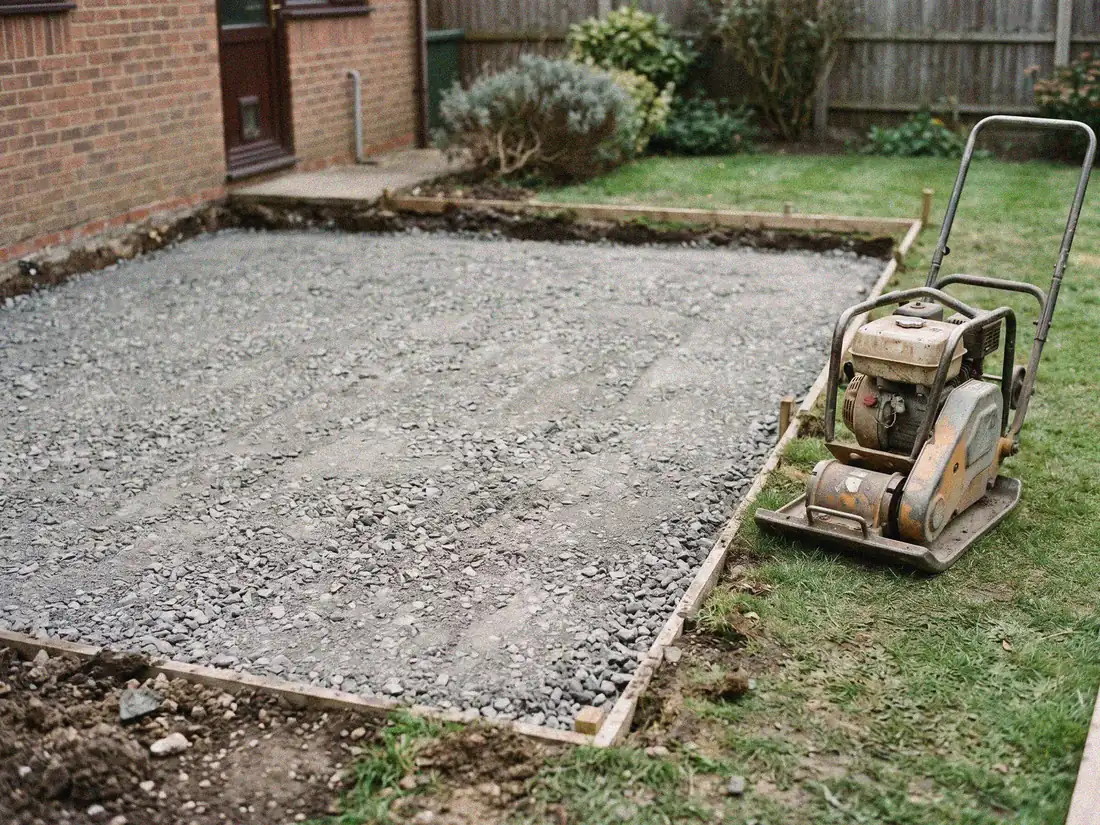
- Dig out to the depth of your sub-base plus whatever goes on top.
- Lay a geotextile membrane on soft ground, to stop the stone pressing into the soil.
- Spread the stone in layers of about 50–75 mm.
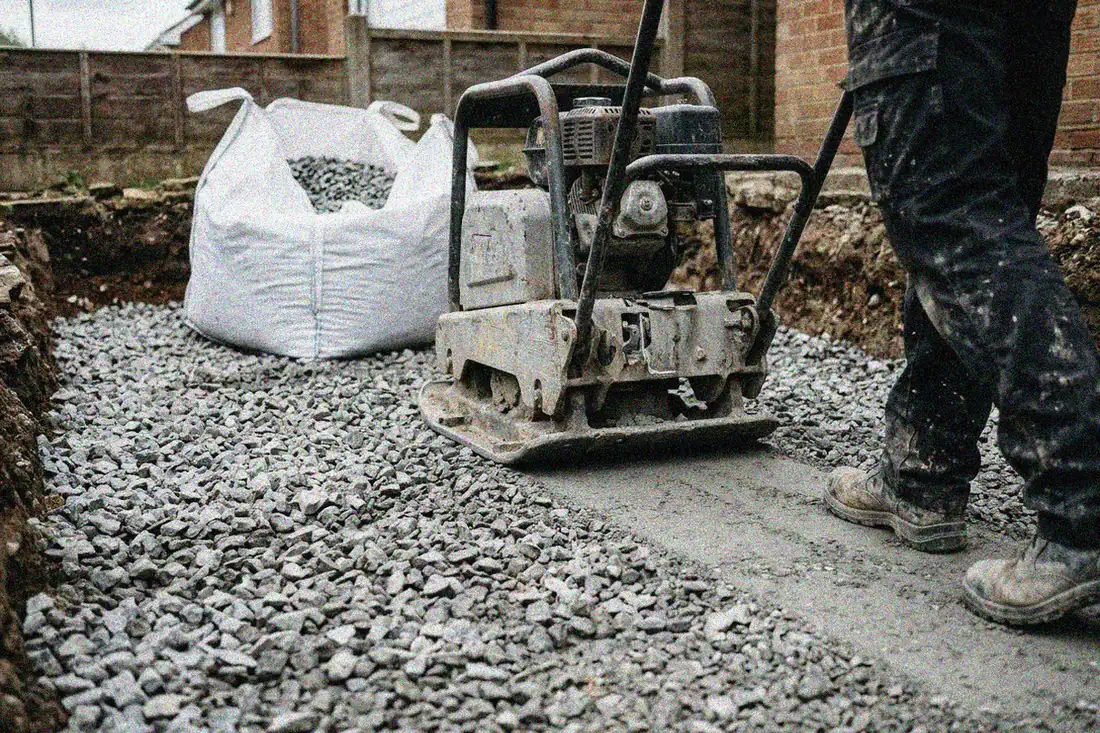
- Compact each layer with a plate compactor, going over it several times in different directions.
- If it’s very dry, a light spray of water helps it bind.
Mistakes to avoid
- Using sand as a sub-base. Sand is for bedding, not support. It shifts and washes out.
- Compacting one thick layer. The top compacts; the bottom doesn’t, and it settles later.
- Using Type 3 under a mortar-bedded patio. It’s built to drain, not to lock solid.
- Hardcore with no Type 1 over it. The gaps in broken brick let the surface settle unevenly.
Calculators for this job
More guides
 UK skip sizes explained: what each skip holds
 How to lay turf: a step-by-step UK guide
 How to lay a self-binding gravel path (UK guide)
Barrowload guide · UK · Figures are typical; always check your product and local rules.