Home / UK calculators / Building and hardscape
Concrete calculator
Work out concrete for slabs, pads and bases. UK units: metres, centimetres and litres. Results update as you type.
How much concrete do I need?
Concrete needed = length × width × depth. An area of 3 m × 3 m at 10 cm deep needs 0.9 m³, about 1.94 tonnes. Order 97 × 20 kg bags, or 0.9 m³ of ready-mix concrete. Order 5–10% extra, as running short mid-pour weakens the slab.
On this page
Key facts
- 1 m³ of concrete needs roughly 108 × 20 kg premix bags.
- A 10 cm (100 mm) slab suits paths, patios and shed bases.
- Order about 5–10% extra.
- Ready-mix is usually easier above about half a cubic metre.
How thick should a concrete slab be?
Common thicknesses for garden and home projects; follow local rules and any engineer’s design:
| Project | Typical thickness | Notes |
|---|---|---|
| Paths and garden pads | 7.5–10 cm | Foot traffic |
| Shed and summerhouse bases | 10 cm | On a compacted sub-base |
| Driveways and parking | 10–15 cm or more | Often reinforced |
Bags or ready-mix?
Bagged concrete mix is usually sold in 20 kg or 25 kg bags at B&Q, Wickes and builders merchants. It’s ideal for small jobs, but at around 100 bags per m³ it quickly becomes heavy work. For anything over about half a cubic metre, ready-mix concrete delivered by truck is usually easier.
Preparing for a pour
- Compact a sub-base first; see the sub-base calculator.
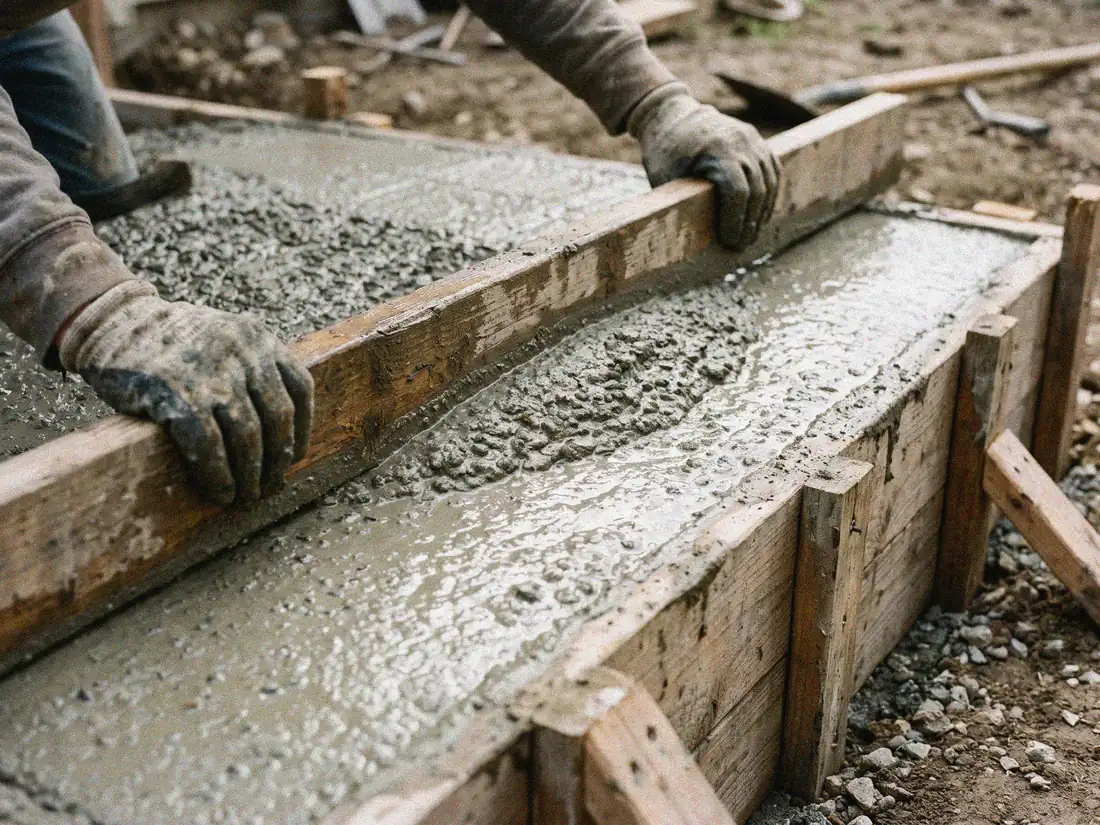
- Build level formwork to the slab thickness.
- Check access for a mixer or truck.
- Plan for curing: keep the slab damp and protected for several days.
How do I work out the cost?
Enter the price per bag in the calculator and it multiplies it by the quantity you need to give an estimated total. Use the Check prices links to see current prices from local retailers. For bulk deliveries priced per tonne or per m³ (or per ton or cubic yard), multiply the quantity in the results by the supplier’s rate instead.
Remember to budget for delivery, any minimum-order or part-load charges, and tool or mixer hire. Prices vary by region and supplier, so compare a few quotes.
How much concrete do common bases need?
Quick figures for typical garden jobs, from this calculator. Add about 10% for uneven ground and spillage.
| Job | Size and depth | Concrete | 20 kg bags |
|---|---|---|---|
| Patio base | 4 × 3 m at 10 cm | 1.2 m³ | 129 |
| Shed base | 3 × 2.4 m at 10 cm | 0.72 m³ | 78 |
| Small shed base | 2.4 × 1.8 m at 10 cm | 0.43 m³ | 47 |
| Parking pad | 6 × 3 m at 15 cm | 2.7 m³ | 291 |
| Each m² at 10 cm | 1 × 1 m at 10 cm | 0.1 m³ | 11 |
Above about 1 m³, ready-mix or on-site mixed concrete is usually far easier than bags; see below. For a step-by-step shed base, read our concrete shed base guide.
Ready-mix and on-site mixed concrete
For anything bigger than a small slab or a few post holes, most people order concrete rather than mixing bags by hand. There are two ways to buy it in the UK:
| Ready-mix (drum truck) | On-site mixed (volumetric truck) | |
|---|---|---|
| How it works | Mixed at the plant and delivered in a drum | Mixed fresh on your drive from separate sand, stone and cement |
| How you order | A set volume in m³, usually ordered in steps such as 0.5 m³ | Often paid by the amount actually used |
| Good for | Known volumes, larger pours | Uncertain volumes, smaller or staged pours |
| Watch out for | Part-load charges on small orders, and waiting-time charges | Minimum charges or call-out fees |
Use the calculator's m³ result to order, and add about 5–10% for uneven ground. Check where the truck can park and how far the concrete needs to travel, as you may need wheelbarrows or a pump.
What mistakes should I avoid?
- Not ordering extra, then running short.
- Uneven ground making the slab thicker than planned.
- Pouring onto soft soil without a sub-base.
- Mixing too wet, which weakens concrete.
How is it calculated?
Volume = length × width × depth, with depth converted to metres (cm ÷ 100). Circles, triangles and L-shapes use the matching area formula. Bag counts use about 2.15 tonnes per m³ of mixed concrete, close to the yield printed on common bags. Bags and bulk amounts are rounded up, because you can’t buy part of a bag.
Worked examples
Garden slab: 3 m × 3 m at 10 cm deep = 0.9 m³, about 1.94 tonnes. Order 97 × 20 kg bags, or 0.9 m³ of ready-mix concrete.
Shed base: 2.4 m × 1.8 m at 10 cm deep = 0.43 m³, about 0.93 tonnes. Order 47 × 20 kg bags, or 0.43 m³ of ready-mix concrete.
Common questions
How many 20 kg bags of concrete in a m³?
Roughly 108, depending on the mix.
How thick should a shed base be?
About 10 cm on a compacted sub-base.
Should I add extra?
Yes, about 5–10% for uneven ground and spillage.
When is ready-mix worth it?
For most slabs over about half a cubic metre, where mixing by hand becomes slow and heavy.
How long does concrete take to cure?
It can usually be walked on after a day or two, but takes weeks to reach full strength. Keep it damp while curing.
How much ready-mix concrete do I need?
Work out the volume in m³ with the calculator, add about 5–10% for uneven ground, then round up to the supplier’s ordering step.
What is on-site mixed concrete?
Concrete mixed fresh at your property by a volumetric mixer truck carrying separate sand, stone and cement. You can often pay only for what you use, which suits uncertain volumes.
Is ready-mix cheaper than bags?
For larger slabs it usually is, and it’s far less work. Bags are practical for small jobs such as post holes and small pads.