Home / UK calculators / Building and hardscape
Patio pointing calculator
Work out how much sand and cement you need to point (grout) the joints of a patio. UK units: metres, centimetres and tonnes. Results update as you type.
How much mortar do I need to point a patio?
Pointing mortar = joint length × width × depth. A 4 × 3 m patio of 600 × 600 mm slabs with 10 mm joints, 25 mm deep: Buy 1 × 25 kg bag of cement and about 18 kg of sand, mixed 4:1 (sand to cement), to point 39 m of joints.
On this page
Key facts
- A 4 × 3 m patio of 600 × 600 slabs has about 39 m of joints.
- Pointing uses far less mortar than bedding: often just a few kilos of cement for a small patio.
- A 4:1 sand-to-cement mix is common for pointing; 3:1 is stronger, for driveways.
- Point joints at least 20 mm deep so the mortar stays in.
Joint widths and depths
| Slab type | Typical joint | Notes |
|---|---|---|
| Porcelain | 3–10 mm | Narrow joints; many use brush-in compound |
| Sandstone | 10–15 mm | Wider joints suit riven stone |
| Concrete slabs | 8–12 mm | Use spacers for even joints |
Smaller slabs mean more joints: the same 4 × 3 m patio in 450 × 450 mm slabs has about 52 m of joints instead of 39 m.
Mortar or jointing compound?
| Sand and cement mortar | Brush-in jointing compound | |
|---|---|---|
| Cost | Lowest | Higher per m² |
| Skill | Needs care to avoid staining | Easier; brushed in |
| Best for | Most slabs, wider joints | Porcelain and quick jobs; follow the product’s guidance |
This calculator works out sand and cement. For compounds, follow the coverage on the tub, which varies by joint size.
How to point a patio
- Wait until the bedding has set, usually at least 24 hours.
- Mix a stiff, damp mortar: it should hold its shape when squeezed.
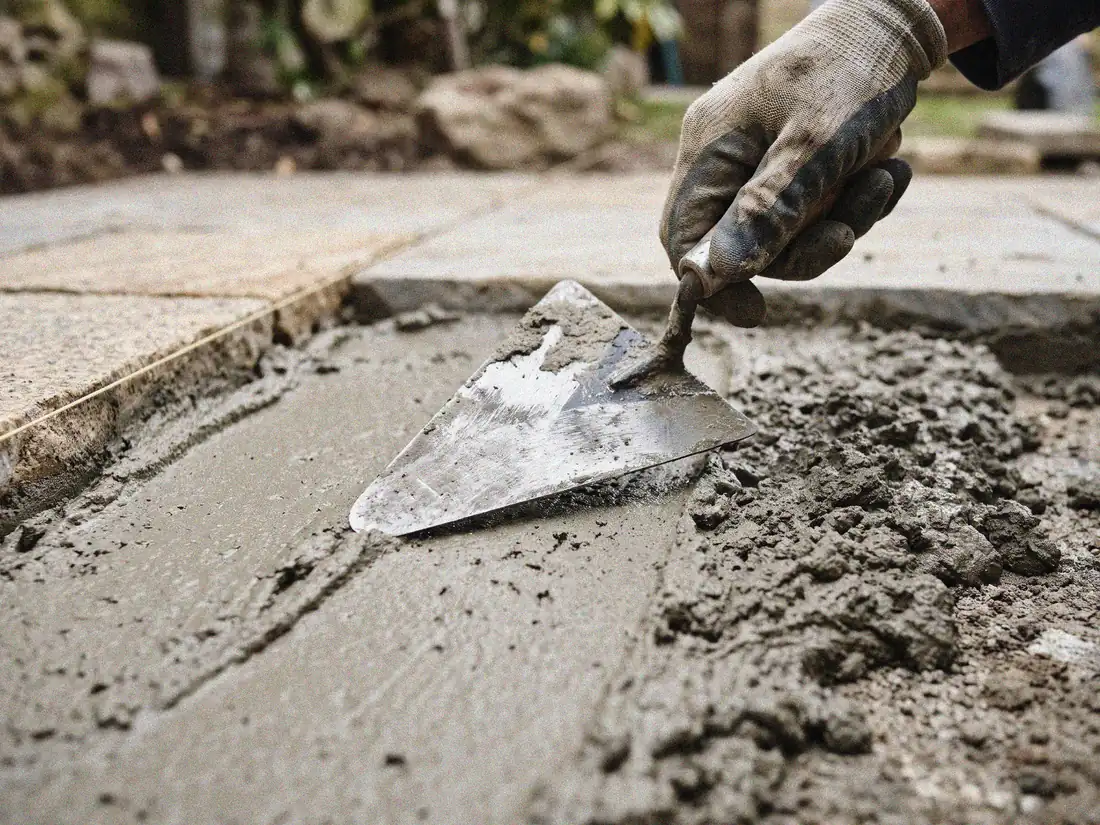
- Press it firmly into the joints with a pointing trowel or pointing iron, filling them fully.
- Strike or smooth the joints for a neat finish.
- Brush off any mortar on the slab faces before it stains, especially on porcelain and pale stone.
- Keep off the patio while it cures and protect it from rain and frost.
What mistakes should I avoid?
- Pointing too shallow, so the mortar cracks out.
- A wet mix that stains the slabs.
- Pointing in frost or heavy rain.
- Leaving mortar smears to dry on the surface.
How is it calculated?
Joint area is the patio area minus the area covered by slabs. Mortar = joint area × depth, plus 10% for waste and 1.33 for dry materials, split by the mix ratio. Cement at 1,440 kg/m³ and sand at about 1,600 kg/m³.
Worked examples
Small patio, 4 × 3 m: Buy 1 × 25 kg bag of cement and about 18 kg of sand, mixed 4:1 (sand to cement), to point 39 m of joints.
Larger patio, 6 × 5 m: Buy 1 × 25 kg bag of cement and about 46 kg of sand, mixed 4:1 (sand to cement), to point 98 m of joints.
What figures do we use?
- Dry-volume factor of 1.33 for mortar
- 10% allowance for waste
- Cement at 1,440 kg/m³; sand at about 1,600 kg/m³
These are typical figures; your materials may differ.
Common questions
How much sand and cement do I need to point a patio?
For a 4 × 3 m patio of 600 × 600 slabs with 10 mm joints, about 4 kg of cement and 18 kg of sand. Smaller slabs and wider joints need more.
What ratio for patio pointing?
4 parts sand to 1 part cement is common; 3:1 is stronger and often used for driveways.
How deep should patio joints be pointed?
At least 20 mm, and ideally the full depth to the bedding, so the mortar can’t crack out.
Sharp sand or building sand for pointing?
Both are used. Building sand gives a smoother finish; some mixes combine the two. Follow your supplier’s advice for the slabs.
When can I point a new patio?
Once the bedding mortar has set, usually after at least 24 hours.
How long before I can walk on it?
Usually after a day or two, but avoid heavy use for longer while it cures.