Home / UK calculators / Lawn
Artificial grass calculator
Work out artificial grass, joining tape, weed membrane and infill sand for your lawn. UK units: metres, centimetres and litres. Results update as you type.
How much artificial grass do I need?
Artificial grass comes in fixed-width rolls, usually 2 m or 4 m wide in the UK, so you order whole strips, not just the lawn area. A 6 m × 4 m lawn with a 4 m roll needs one strip of about 6.1 m, or roughly 25.6 m² including a little extra, plus about 5 × 25 kg bags of kiln-dried sand.
On this page
Key facts
- UK artificial grass rolls are usually 2 m or 4 m wide.
- You order whole strips, so you usually buy more than the lawn area.
- Kiln-dried sand infill is usually 4–8 kg per m².
- All strips must have the pile facing the same way.
Roll widths and how to lay strips
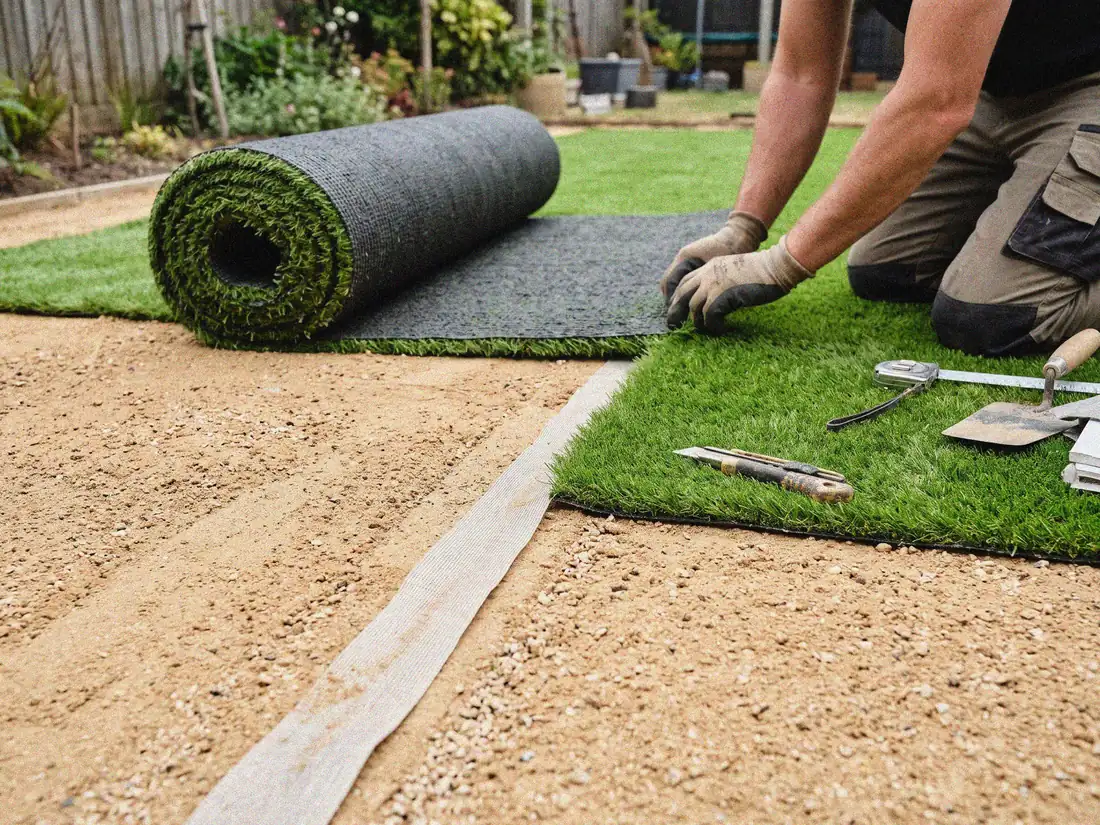
Rolls are cut to the length you order. If your lawn is wider than one roll, strips are laid side by side and joined. The calculator checks both directions and picks the layout that wastes least grass, and adds about 10 cm to each strip for trimming.
| Lawn size | Best roll | Strips | Grass to order (+5%) |
|---|---|---|---|
| 6 m × 4 m | 4 m wide | 1 × 6.1 m | about 25.6 m² |
| 7 m × 5 m | 4 m wide | 2 × 5.1 m | about 42.8 m² |
All strips must have the pile facing the same way, or the joins will show. Most people lay the pile facing the house or the main viewpoint.
Everything you need
- Artificial grass, in strips from the calculator.
- Joining tape and adhesive for each seam between strips.
- Weed membrane, allowing about 10% overlap.
- Kiln-dried sand infill, usually 4–8 kg per m² depending on pile height; check your grass maker’s guidance. Some grasses don’t need infill.
- A sub-base of compacted crushed stone, often topped with a levelling layer of sharp sand or granite dust. Use the MOT Type 1 calculator for the base.
- Fixing pins or edging around the perimeter. The lawn edging calculator works out lengths.
How to measure an awkward lawn
Measure the longest length and widest width, so the rectangle covers the whole lawn. Curves and corners are trimmed from the strips once laid. For lawns made of distinct sections, work out each section separately and add them together.
How do I work out the cost?
Enter the price per m² in the calculator and it multiplies it by the quantity you need to give an estimated total. Use the Check prices links to see current prices from local retailers.
Remember to budget for the base materials, joining tape, adhesive, infill, edging and installation if you’re not laying it yourself. Prices vary by region and supplier, so compare a few quotes.
What mistakes should I avoid?
- Ordering only the lawn area in m². Because rolls are fixed widths, you nearly always need more than the area.
- Mixing pile directions. Strips laid in different directions look like different colours.
- No trim allowance. Edges are rarely perfectly straight; the extra 10 cm per strip covers this.
- Skipping the base. Laying straight onto soil leads to dips and weeds.
How is it calculated?
Strips = lawn width ÷ roll width, rounded up, checked in both directions. Grass to order = strips × roll width × (strip length + 10 cm), plus your extra for cuts. Joining tape = (strips − 1) × strip length. Infill = lawn area × infill rate.
Worked examples
Small lawn: 6 m × 4 m with a 4 m roll = 1 strip of 6.1 m = 24.4 m², plus 5% = about 25.6 m². Infill at 5 kg/m² = 120 kg, or 5 × 25 kg bags.
Wider lawn: 7 m × 5 m with a 4 m roll. Running strips across the 7 m side needs 2 strips of 5.1 m (40.8 m²); the other way needs 2 strips of 7.1 m (56.8 m²). The calculator picks the first, saving 16 m². With 5% extra, order about 42.8 m² and 5.1 m of joining tape.
Common questions
What widths does artificial grass come in?
In the UK, usually 2 m and 4 m, with some ranges in 5 m. The roll is cut to the length you order.
How much kiln-dried sand do I need for artificial grass?
Usually 4–8 kg per m², depending on the grass and pile height. For a 24 m² lawn at 5 kg/m², that’s 120 kg, or 5 × 25 kg bags.
Which way should artificial grass face?
Usually with the pile facing the house or main viewpoint, and every strip facing the same way.
What goes under artificial grass?
Typically a compacted crushed-stone sub-base, a levelling layer of sharp sand or granite dust, and a weed membrane.
Do I need joining tape?
Only if you have more than one strip. Each seam needs joining tape and adhesive along its full length.