Gravel driveways in Australia: road base and how much to order
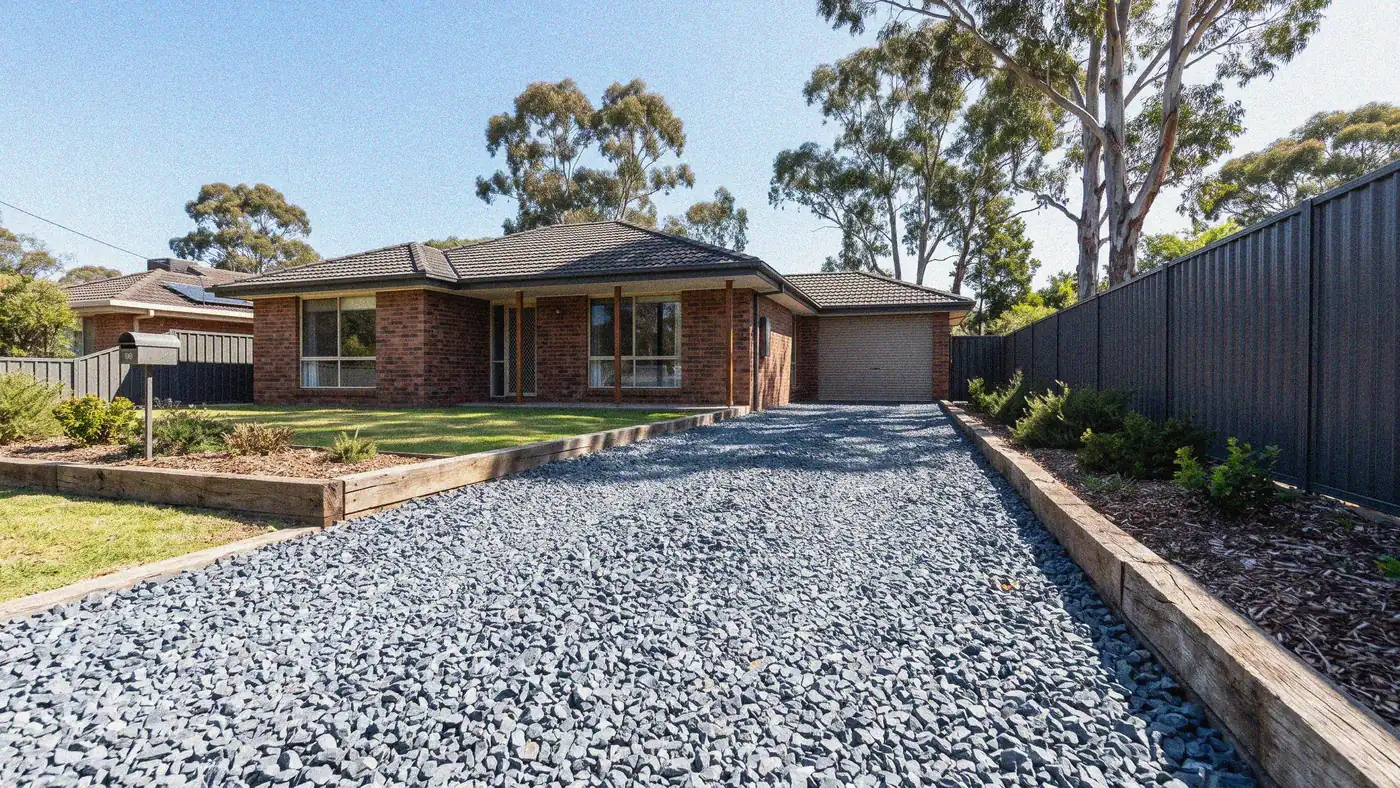
Most Australian gravel driveways are built the same way: a compacted layer of road base, then a topping of crushed rock or gravel. Here’s how to work out what to order, and what to watch for along the way.
The short version
For a driveway that carries cars, plan on about 15 cm of compacted road base topped with about 5 cm of crushed rock. A typical 10 × 3 m driveway needs roughly 9.5 tonnes of road base and 2.6 tonnes of 20 mm crushed rock, usually delivered loose by a landscape supplier.
Before you start
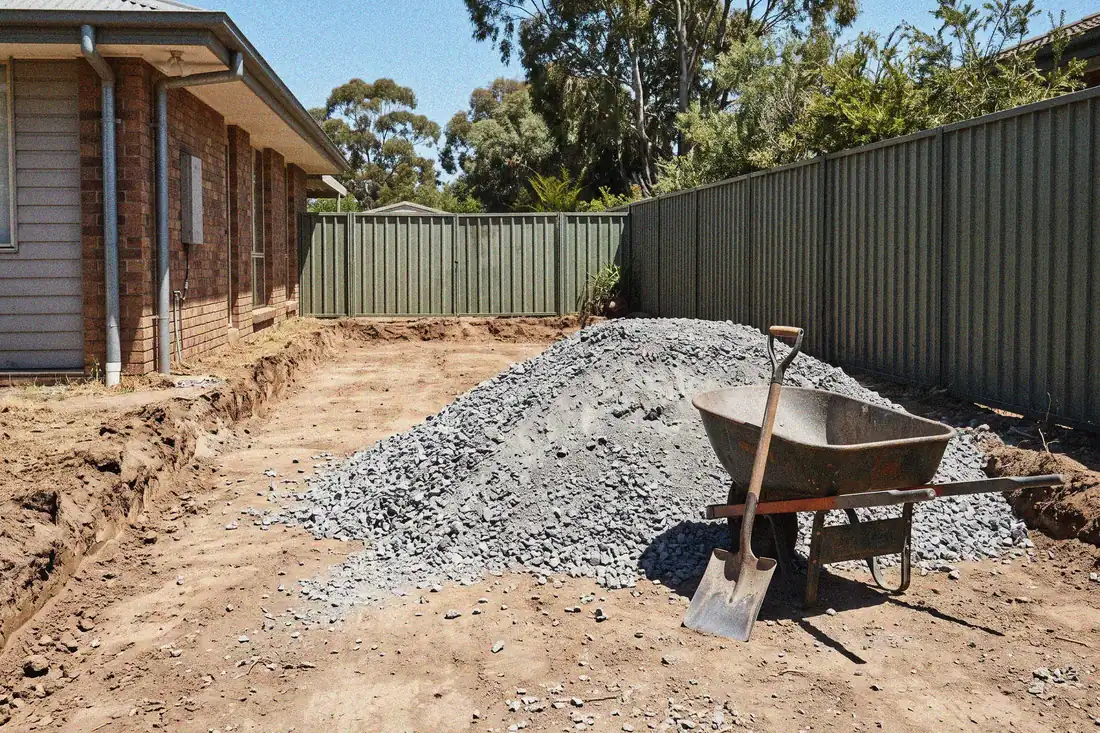
The crossover. The section between your boundary and the road (the vehicle crossover) usually belongs to the council and needs their approval, often with specific materials. Check with your council before touching it.
Drainage. Heavy summer storms can wash a gravel drive away. Give the base a gentle fall so water runs off to the side rather than down the length of the drive, and think about where it ends up.
Access for deliveries. A truck tipping 10 tonnes of road base needs room to reverse in and somewhere to drop it. Many people tip it straight onto the prepared driveway area to save barrowing.
The layers
| Layer | Typical depth | Notes |
|---|---|---|
| Road base | 15 cm compacted for cars | A crushed rock blend with fines that compacts hard. Lay and compact in layers. |
| Crushed rock topping | About 5 cm | Angular rock around 14–20 mm holds better under tyres than round pebbles |
| Edging | At finished height | Timber or concrete sleepers, steel edging or a concrete kerb all work |
Road base is sold under different names depending on where you are, and blends vary between suppliers. Ask yours what they recommend for a driveway in your soil.
Worked example: a 10 × 3 m driveway
| Item | Calculation | Amount |
|---|---|---|
| Road base | 10 × 3 m × 15 cm × 2.1 t/m³ | About 9.5 tonnes (4.5 m³ compacted) |
| 20 mm crushed rock | 10 × 3 m × 5 cm × 1.7 t/m³ | About 2.6 tonnes (1.5 m³) |
| Soil to remove | 10 × 3 m × 20 cm, bulking about 25% | About 7.5 m³ loose, so plan for a skip bin or two |
Plug your own measurements into the road base calculator, the driveway gravel calculator and the skip bin size calculator. Suppliers usually sell by the tonne or cubic metre, so it helps to have both figures handy when you ring around.
Choosing your topping
| Topping | Good for | Watch out for |
|---|---|---|
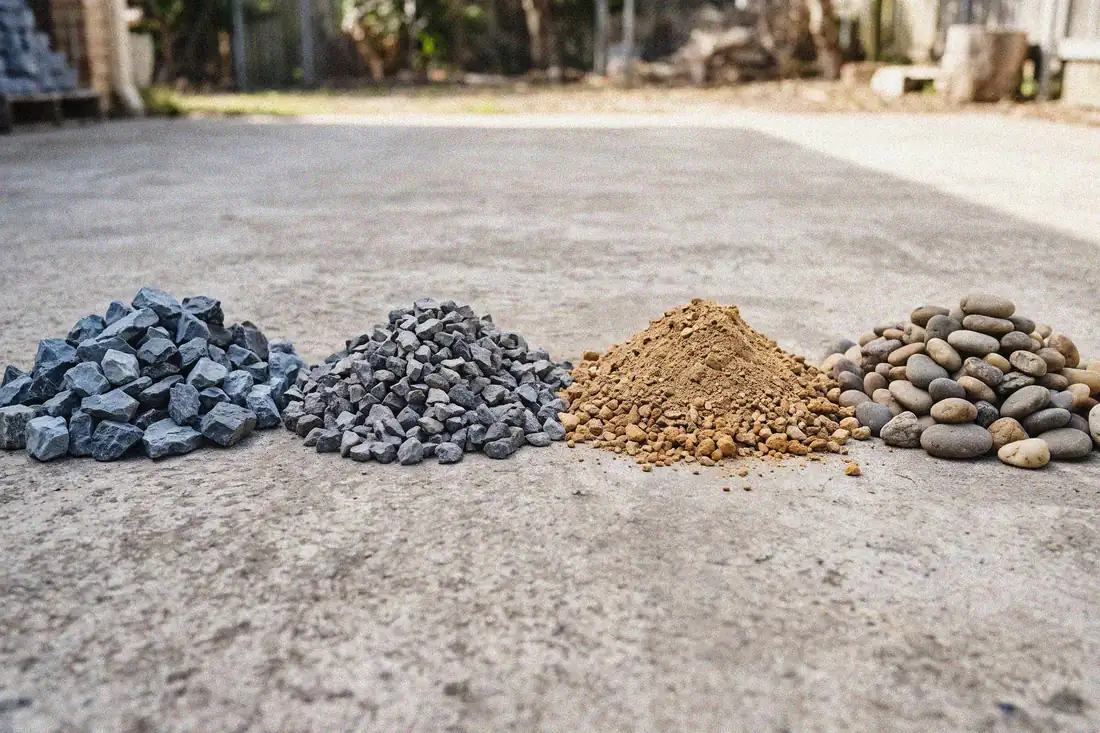
| 20 mm crushed rock or blue metal | Most driveways: angular, stable, drains well | Can feel loose if laid too deep |
| 14 mm crushed rock | A slightly smoother finish | Moves a little more than 20 mm |
| Decomposed granite | A natural, compacted look on flat drives | Can wash out on slopes and track indoors |
| River pebbles | Garden beds and borders | Rolls under tyres; not ideal for driveways |
How much barrowing to expect
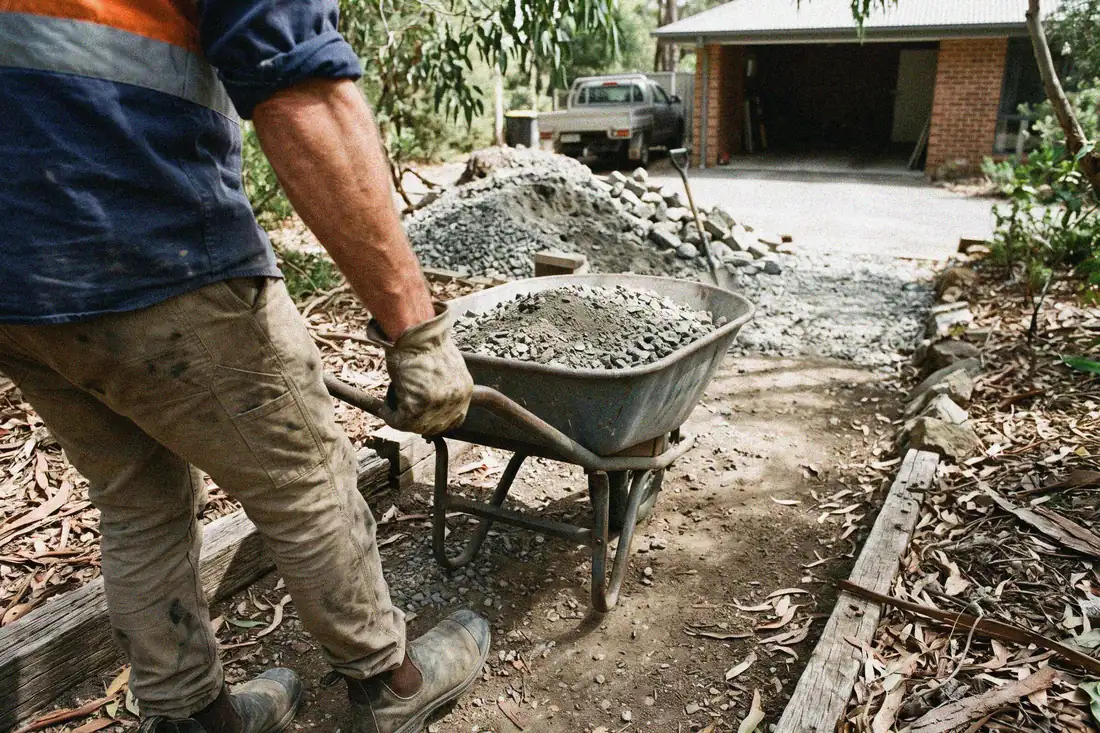
If the truck can’t tip straight onto the drive, everything moves by wheelbarrow. For the 10 × 3 m example, 4.5 m³ of road base is roughly 53 loads in an 85 litre barrow, and the crushed rock another 18 or so. That’s a big weekend, so it’s worth paying for a tip-on-site delivery or hiring a mini loader if access allows.
What to avoid
- Using crusher dust as the surface. It compacts well as a base, but on top it turns to mud in the wet and dust in summer.
- Round pebbles on a slope. They roll and rut. Save them for garden beds.
- Compacting road base dry. A light spray of water helps it bind and compact much harder.
- Skipping the edging. Without it, the rock spreads into garden beds within months.
Step by step
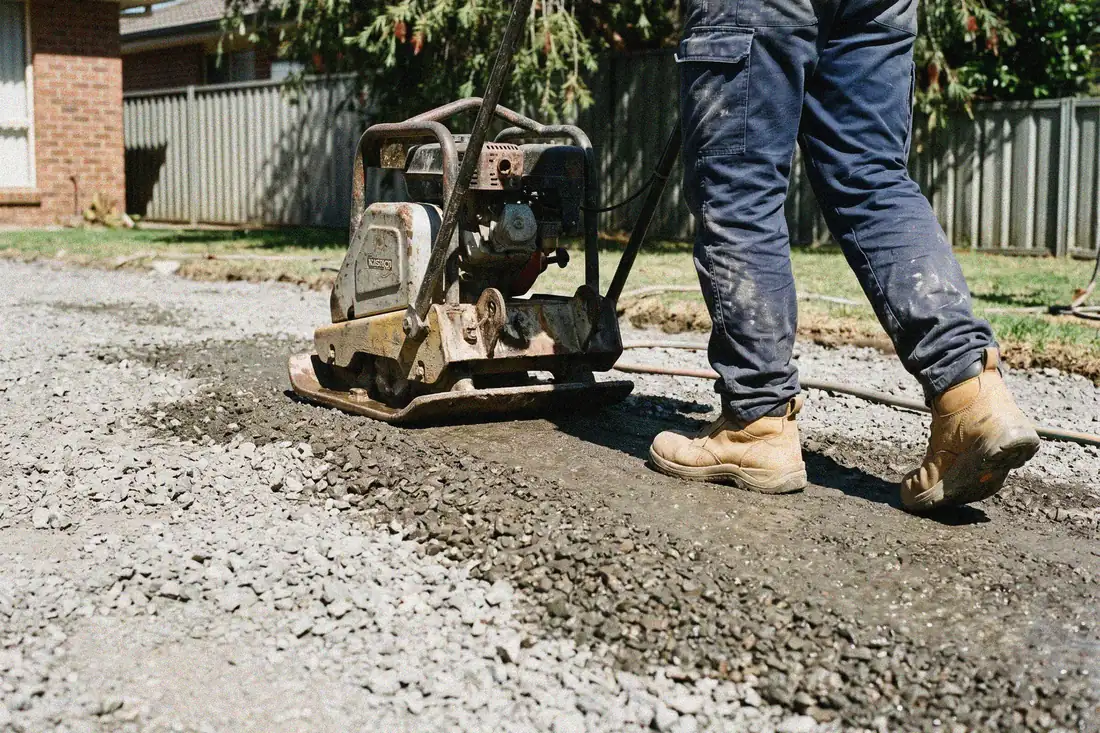
- Mark out the drive and dig out to about 20 cm.
- Compact the ground, and lay geotextile fabric if the soil is soft or reactive clay.
- Fix the edging.
- Spread the road base in layers of about 5–7.5 cm, dampen it, and compact each layer with a plate compactor.
- Spread the crushed rock topping evenly and roll or compact it lightly.
Upkeep
After heavy rain, check for washouts and rake material back into place. Top up the crushed rock every few years as it beds in and spreads.
Calculators for this job
More guides
 How to build a raised garden bed in Australia
 Crusher dust vs road base: which do you need?
 How to lay synthetic grass in Australia
Barrowload guide · Australia · Figures are typical; always check your product and local rules.