Home / Australia calculators / Lawn
Synthetic grass calculator
Work out synthetic grass, joining tape, weed membrane and infill sand for your lawn. Australian units: metres, centimetres and litres. Results update as you type.
How much synthetic grass do I need?
Synthetic grass comes in fixed-width rolls (usually 2 m or 4 m), so you order whole strips, not just the area. A 6 m × 4 m lawn: Order 25.6 m² of synthetic grass (1 strip of 6.1 m from a 4 m roll) and 8 bags of infill sand.
On this page
Key facts
- Synthetic grass rolls are usually 2 m or 4 m wide.
- You order whole strips, so you usually buy more than the lawn area.
- Silica sand infill is usually 5–8 kg per m².
- All strips must have the pile facing the same way.
Roll widths and strips
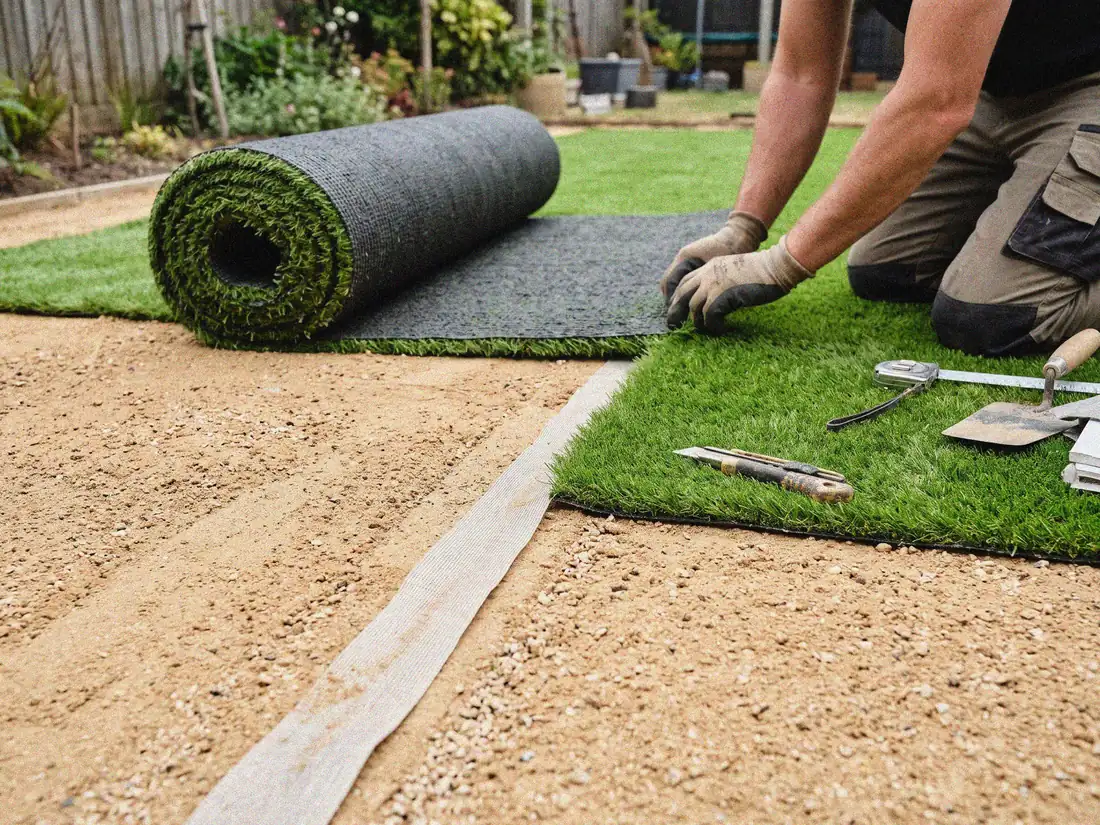
Strips are laid side by side and joined. The calculator checks both directions and picks the layout that wastes least, adding a little to each strip for trimming. Every strip must have the pile facing the same way.
Everything you need
- Synthetic grass, in strips from the calculator.
- Joining tape and adhesive for each seam.
- Weed membrane, with about 10% overlap.
- Infill: usually 5–8 kg of silica sand per m².
- A base of compacted crushed rock; see the road base calculator.
- Edging; see the edging calculator.
How to measure an awkward lawn
Measure the longest length and widest width, so the rectangle covers the whole lawn; curves are trimmed after laying. For lawns with separate sections, work each out separately.
Preparing the base
- Remove the existing turf and about 7–10 cm of soil.
- Lay and compact a crushed rock base.
- Add a thin levelling layer of fine crushed rock or sand.
- Lay weed membrane, then the grass.
How do I work out the cost?
Enter the price per m² in the calculator and it multiplies it by the quantity you need to give an estimated total. Use the Check prices links to see current prices from local retailers.
Remember to budget for the base materials, joining tape, adhesive, infill, edging and installation if you’re not laying it yourself. Prices vary by region and supplier, so compare a few quotes.
What mistakes should I avoid?
- Ordering only the area. Fixed widths usually mean ordering more.
- Mixed pile directions, which show as colour differences.
- No trim allowance.
- No proper base.
How can I save time and money?
- Order all grass from one batch so colours match.
- Plan seams away from the main viewpoint where possible.
- Use a sharp knife and change blades often for clean cuts.
- Brush the pile up after laying and after infilling.
- Keep offcuts for repairs.
How is it calculated?
Strips = width ÷ roll width, rounded up, checked both ways. Order = strips × roll width × strip length, plus extra. Infill = area × rate.
Worked examples
Small lawn: 6 m × 4 m: Order 25.6 m² of synthetic grass (1 strip of 6.1 m from a 4 m roll) and 8 bags of infill sand.
Wider lawn: 7 m × 5 m: Order 42.8 m² of synthetic grass (2 strips of 5.1 m from a 4 m roll), 5.1 m of joining tape and 11 bags of infill sand.
Common questions
What widths does synthetic grass come in?
Usually 2 m and 4 m.
How much infill sand do I need?
Usually 5–8 kg per m²; follow your supplier.
Which way should it face?
With the pile facing the main viewpoint, all strips the same way.
What goes underneath?
A compacted crushed-rock base, a fine levelling layer and a weed membrane.
Do I need joining tape?
Only where strips meet, along each seam.
How long does artificial grass last?
Quality grass often lasts many years with good installation and care; heavy use and sunlight shorten its life.
Can I lay it on concrete?
Yes, with a foam underlay and drainage holes or a slight fall, following the product guidance.