How to build a gravel driveway (US guide)
A gravel driveway is one of the most affordable driveways you can build, and it lasts for years when it’s built in layers. Most problems (ruts, potholes, gravel migrating into the lawn) trace back to skipping the base.
How do you build a gravel driveway?
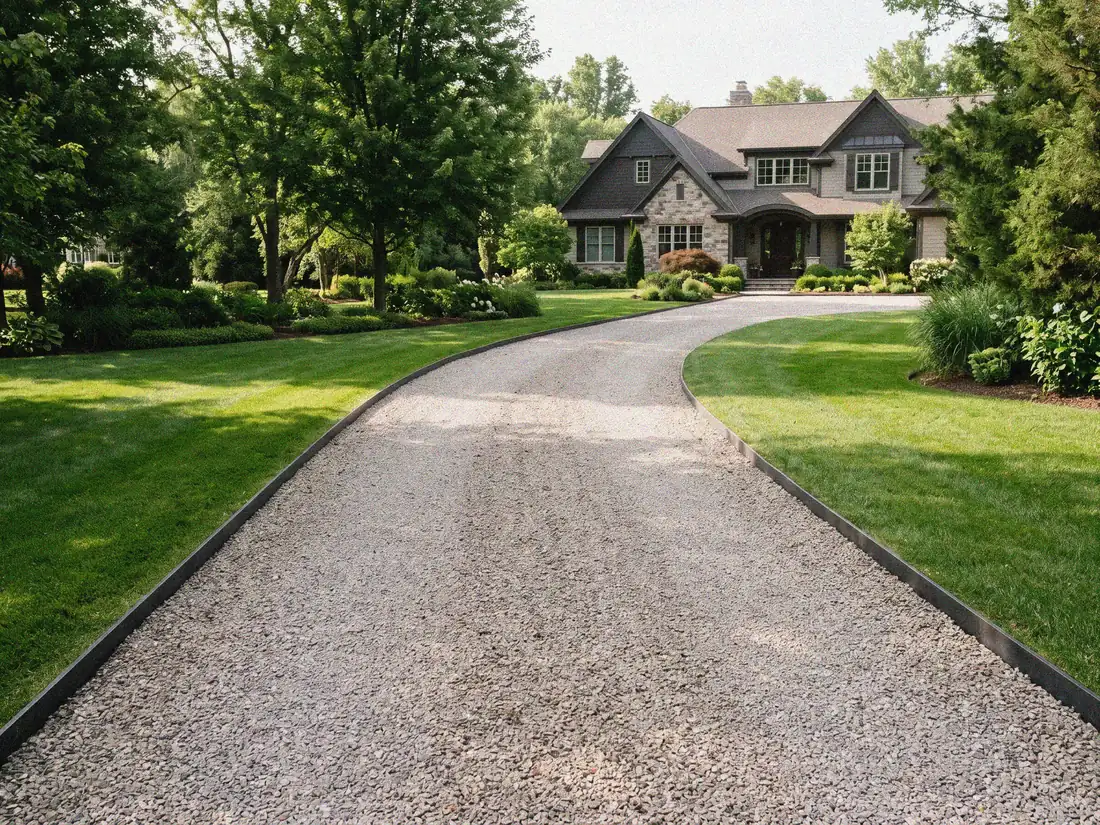
Dig out the soft soil, lay and compact about 6 in of crushed stone base, then spread 2–4 in of angular surface gravel with a slight crown so water runs off. A 40 × 10 ft driveway needs about 7.4 cubic yards (13 tons) of base and 3.7 cubic yards (5.3 tons) of surface gravel at 3 in.
What layers does a gravel driveway need?
| Layer | Typical depth | What it does |
|---|---|---|
| Geotextile fabric (optional) | — | Separates the stone from soft soil, so it doesn’t sink in |
| Compacted crushed stone base | About 6 in | Carries the weight of vehicles |
| Surface gravel (angular) | 2–4 in | The driving surface |
How do I build the base?
- Mark out the driveway and remove grass, roots and topsoil.
- Dig down to firm subsoil, deep enough for the base and surface layers.
- Lay geotextile fabric if the ground is soft or clay-heavy.
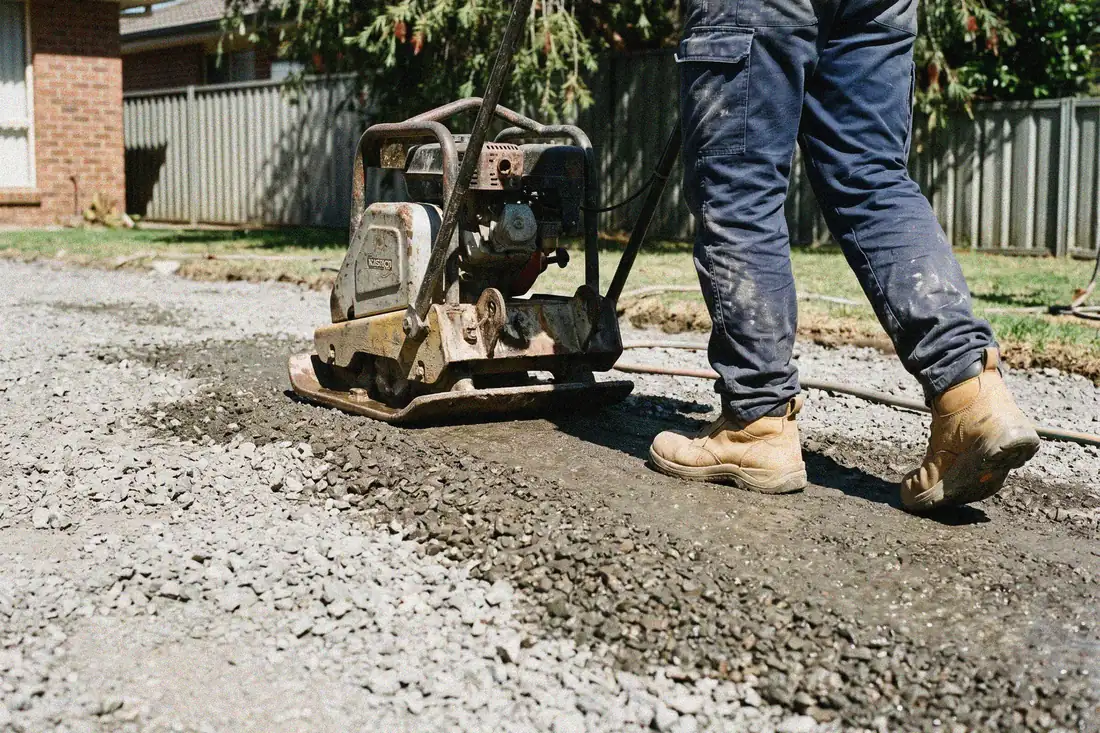
- Spread the base stone in layers and compact each layer with a plate compactor or roller.
- Shape a slight crown or cross-slope so rain runs off the driveway rather than pooling in ruts.
Which surface gravel is best?
Angular crushed stone locks together and stays put; round pea gravel rolls under tires and spreads. On slopes, plastic gravel grids under the surface layer help stop gravel washing down and ruts forming.
How much do I need for a 40 × 10 ft driveway?
| Layer | Amount | Calculator |
|---|---|---|
| Compacted base (6 in) | 7.41 cu yd, about 13.1 tons | Paver base |
| Surface gravel (3 in) | 3.7 cu yd, about 5.3 tons | Driveway gravel |
At this size, buying in bulk from a landscape supply yard is far cheaper than bags. Crushed stone weighs roughly 2,870 lb per cubic yard, so check the delivery truck can reach the site.
How do I maintain a gravel driveway?
- Rake gravel back into ruts and wheel tracks every few months.
- Top up the surface layer as gravel works into the base or out to the edges.
- Keep drainage clear so water doesn’t soften the base.
- Use a plastic blade or skids when plowing snow, to avoid scraping up the gravel.
Do I need a permit?
Often not for the driveway itself, but if it joins a public road, your city, county or state highway department may require a permit for the entrance, and sometimes a culvert pipe where it crosses a roadside ditch. Some HOAs also have rules on driveway materials. Check with your local road authority before you start.
What mistakes should I avoid?
- No base layer: gravel spread on soil sinks and ruts quickly.
- Too thick a surface layer: deep loose gravel is hard to drive and walk on.
- Round gravel on slopes or turning areas.
- No edging, so gravel creeps into the lawn.
Calculators for this job
More guides
 How to fill a raised garden bed: soil mix and how much to buy
 How to lay pavers: base, sand and joints (US guide)
 Topsoil vs fill dirt: which one do you need?
Barrowload guide · US · Figures are typical; always check your product and local rules.