Home / US calculators / Building and hardscape
Retaining wall block calculator
Work out blocks and cap blocks for a garden retaining wall. US units: feet, inches and cubic feet. Results update as you type.
How many retaining wall blocks do I need?
Blocks = (wall length ÷ length of one) × (height ÷ height of one), each rounded up. A 20 ft × 2 ft wall: Order 126 wall blocks plus 21 cap blocks.
On this page
Key facts
- Common retaining wall blocks are about 11.75 × 4 in on the face.
- Walls over about 3–4 ft usually need engineering and a permit.
- Cap blocks finish the top course.
- Retaining walls need drainage behind them.
Common sizes
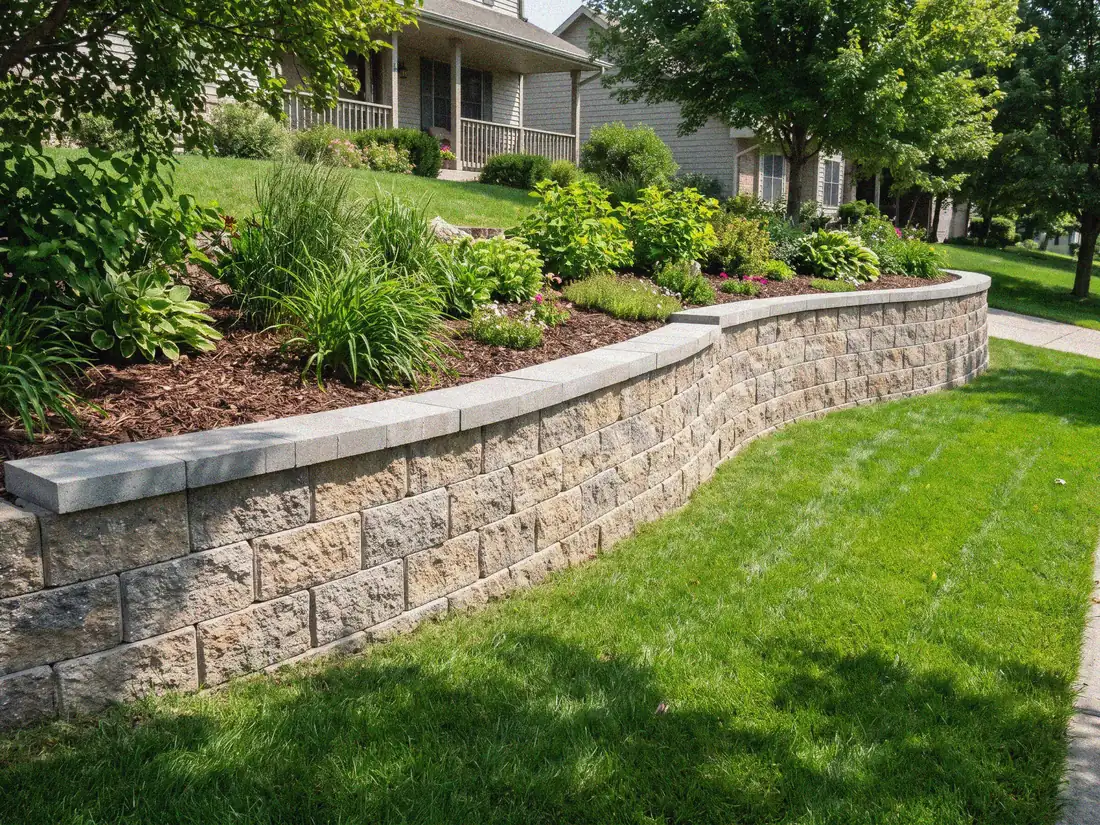
Common retaining wall blocks are about 11.75 in long and 4 in high, often used with matching cap blocks for the top course. Check the dimensions on your block.
Building it properly
- Bury part of the first block course for stability, following the product guidance.
- Lay a compacted base of crushed rock under the first course.
- Add drainage: gravel backfill and a perforated pipe behind the wall.
- Stagger joints between courses and set back each course if the block design requires it.
Height limits
Walls over about 3–4 ft usually need engineering and a permit. Check your local building rules before you build.
Building steps in brief
- Mark the wall line and dig a level trench.
- Lay and compact a crushed rock base.
- Set the first course partly below ground, level along its length.
- Add drainage gravel and a perforated pipe behind the wall.
- Build up the courses, backfilling as you go.
- Finish with cap blocks fixed with adhesive.
What mistakes should I avoid?
- No drainage, so water pressure pushes the wall over.
- No compacted base.
- Forgetting the buried course when counting.
- Building too high without advice.
How can I save time and money?
- Order a few extra blocks for cuts and breakages.
- Plan the wall height in whole block heights to avoid cutting.
- Hire a plate compactor for the base.
- Check delivery access; sleepers and blocks are heavy.
- Get advice early for walls near boundaries, buildings or slopes.
How is it calculated?
Per course = length ÷ unit length, rounded up. Courses = height ÷ unit height, rounded up. Total = per course × courses.
Worked examples
Garden wall: 20 ft × 2 ft: Order 126 wall blocks plus 21 cap blocks.
Low wall: 12 ft × 1.33 ft: Order 52 wall blocks plus 13 cap blocks.
Common questions
How many blocks do I need?
Multiply the number per course by the number of courses.
How high can I build a retaining wall?
Over about 3–4 ft usually needs engineering and a permit.
Do retaining walls need drainage?
Yes. Gravel backfill and a drainage pipe stop water pressure building up.
Should the first course be buried?
Many designs bury part of the first course; follow the product guidance.
What size are retaining wall blocks?
Commonly about 11.75 × 4 in on the face.
Do I need posts?
Most segmental block walls don’t use posts; they interlock.
How long do timber sleepers last?
Treated timber sleepers typically last many years; hardwood and concrete last longer. Ground contact and drainage make a big difference.
Can I build a retaining wall on a slope?
Yes, often by stepping the base. Each step should be level and well compacted.