Home / US calculators / Lawn
Lawn topdressing calculator
Work out how much compost you need to topdress your lawn. US units: feet, square feet and pounds. Results update as you type.
How much topdressing do I need?
Compost needed = lawn area × depth. A 50 × 40 ft lawn (2,000 sq ft) at ¼ in needs 41.7 cu ft (1.54 cu yd). Order 42 × 1 cu ft bags of compost, or about 1.54 cubic yards in bulk.
On this page
Key facts
- Compost topdressing is usually ¼–½ in deep on established lawns.
- A cubic yard covers about 1,300 sq ft at ¼ in.
- Aerating first helps topdressing reach the soil.
- Cool-season lawns are usually topdressed in early fall.
How thick should top dressing be?
| Job | Typical depth | Notes |
|---|---|---|
| Routine compost topdressing | ¼ in | After core aeration |
| Building soil over time | up to ½ in | Penn State Extension suggests ¼–½ in on established lawns |
| Bare patches | up to 1 in | Reseed afterwards |
Don’t bury the grass. Layers thicker than about ½ in can smother the grass crowns and block light, so the calculator warns you above that depth. It’s better to apply two thin layers a few weeks apart.
Choosing a top dressing
In the US, screened compost is the most common topdressing for home lawns: it adds organic matter and helps soil biology without burying the grass. Sand topdressing is mainly used for leveling and on sports turf. Use fine, screened compost; coarse compost with wood chips won’t settle into the grass.
Compost is sold in bags (often 1 cu ft) or in bulk by the cubic yard. One cubic yard is 27 cu ft, enough for about 1,300 sq ft at ¼ in.
How to top dress a lawn
- Mow the lawn a little shorter than usual.
- Scarify or rake out thatch, and aerate compacted areas.
- Spread the top dressing evenly with a shovel or spreader.
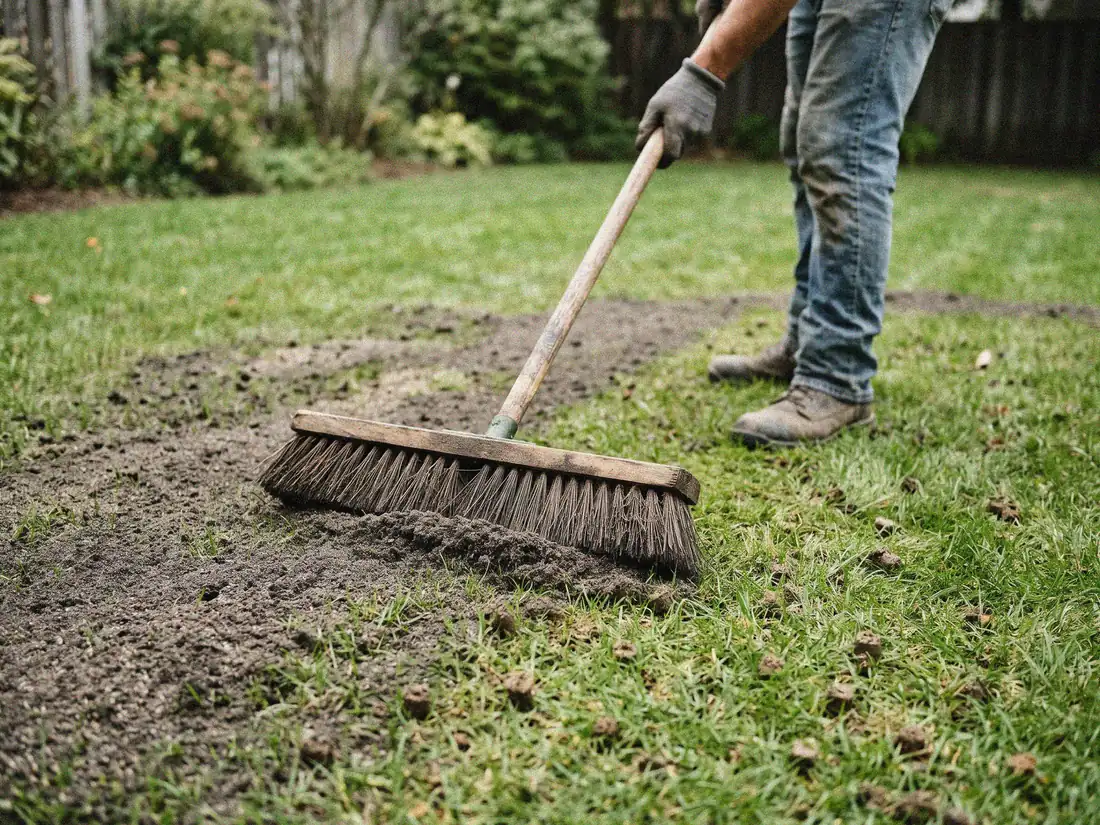
- Work it into the grass with the back of a rake or a brush (a lute or level rake works well).
- Water lightly if the weather is dry.
When to top dress
Cool-season grasses (fescue, bluegrass, ryegrass): early fall after aeration, or early spring. Warm-season grasses (Bermuda, zoysia): late spring when growing strongly. Avoid summer heat stress and dormancy.
What mistakes should I avoid?
- Spreading it too thick, which smothers the grass.
- Using unscreened material full of stones or wood.
- Skipping aeration, so the dressing sits on top instead of filling holes.
- Top dressing when the grass isn’t growing.
How is it calculated?
Volume = area × depth (inches ÷ 12 for feet; cubic feet ÷ 27 = cubic yards). Weight uses a typical 0.6 tonnes per m³ for compost. Bags are counted by volume and rounded up.
Worked examples
Routine topdressing: 2,000 sq ft at ¼ in = 41.7 cu ft (1.54 cu yd). Order 42 × 1 cu ft bags of compost, or about 1.54 cubic yards in bulk.
Building soil: 30 × 20 ft (600 sq ft) at ½ in = 25 cu ft (0.93 cu yd). Order 25 × 1 cu ft bags of compost.
Sources
Figures and guidance on this page draw on:
- Penn State Extension guidance on compost topdressing depth (¼–½ in on established lawns), as widely cited
- A typical compost bulk density (about 0.6 t/m³)
- US bag sizes (1–2 cu ft)
Always check the instructions on your product, as rates vary.
Common questions
How much top dressing do I need per 1,000 sq ft?
At ¼ in deep, about 21 cu ft (0.77 cubic yards) per 1,000 sq ft.
How thick should top dressing be?
Usually ¼–½ in of compost on established lawns.
Can I use topsoil to top dress?
For filling small dips, a sieved soil or sandy mix works. Heavy topsoil can seal the surface, so blend it with sand or use a dedicated top dressing.
Should I aerate before top dressing?
Yes, ideally. Aeration holes let the dressing reach the soil and improve drainage.
How often should I top dress?
Once or twice a year is plenty for most home lawns.
Can I top dress and overseed together?
Yes. Sow the seed, then apply a thin layer of top dressing to cover it lightly. Use the seed calculator for the seed.
How much compost to topdress a lawn per square foot?
At ¼ in deep, about 0.02 cu ft per sq ft, or 21 cu ft per 1,000 sq ft.
How much does a cubic yard of compost cover?
About 1,300 sq ft at ¼ in, or 650 sq ft at ½ in.
Why is top dressing heavy?
Compost is light compared with sand, but a cubic yard can still weigh over 1,000 lb when moist; plan for wheelbarrow trips.